How is learning generated?
After writing the areas of learning, for RPL, I thought it would be a great idea to write a blog for clarity of ideas and to spark some light bulb moments, to help clarify how my learning has evolved and how it is being used currently during my MA.
When watching Richard Alston's approach to making using an existing influence, I started to think about where learning generates from and that it must be influenced by an idea or concept. Well, if learning is generated through influence of another person or concept, then what is an influencer. McCorquodale (2019) discusses an influencer in the context of social media, and how a person builds a digital audience by sharing areas of their life. Relating this to learning, ideas must be shared by others, could be researchers, those within professional practice or experiential learners, for all learners to use the information, take influence and apply it within a different context or method. This is evident when Richard Alston imagines Diaghlev has asked him to create a piece. Throughout Alston's video, prior knowledge of Diaghlev is imparted, meaning Diaghlev has passed on his own experiences within a public and artistry context, to influence others.
As I watch for learning intent, rather than pleasure at first, I realise I have already created my own concepts, opinions and questions just from watching Richard Alston's making process. The way he uses intricate and intrinsic thoughts and models them through practice, creating a relationship between language and practice. As I observe Alston's process, it is almost as I can visualise his process, which then influences me to create a viewpoint and discussion because of the fluent nature of learning inspiring my own thinking. We see this when Alston discusses Diaghlev's nature to mentor emerging choreographers, and at this point I questioned 'Well surely the outcome for all choreographers must be the same if instructed/guided by the same choreographer'. They have had the same information, applied it, why is their outcome different? This is because processing information is different for all, and application of ideas follow an individual learning and processing journey. This is the same with making, Alston chose to set himself a stimulus as his inspiration, a piece of music very relatable to Diaghlev, but the transition of ideas took a very varied course to what Diaghlev would have produced with this stimulus.
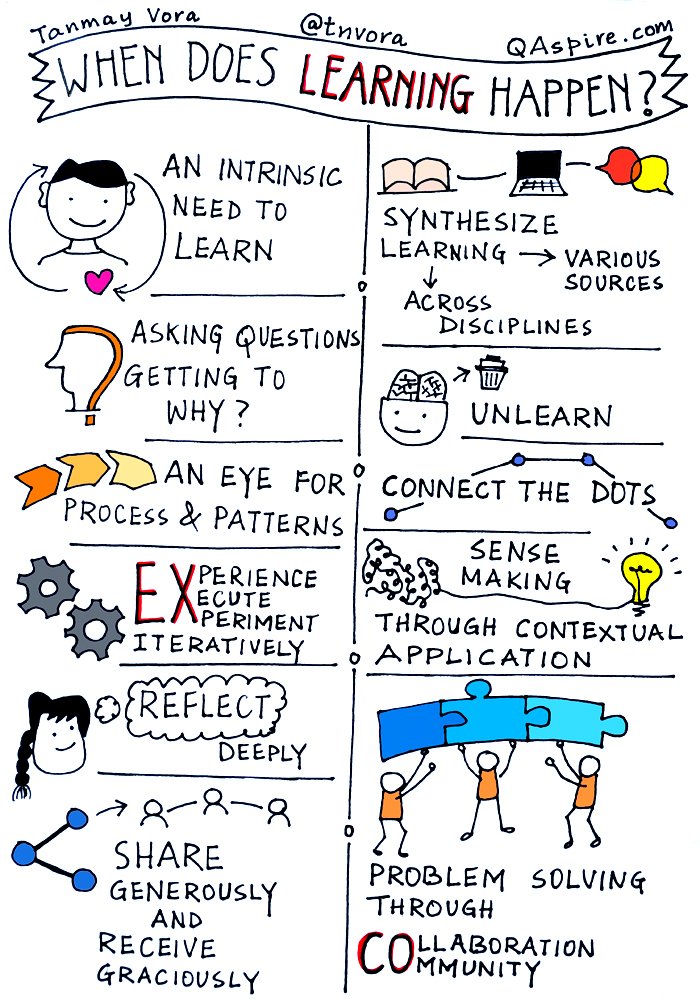
The below image demonstrates why learning happens. Watching Alston's video, made me question my learning in the present rather than after the event occured. The point below about an intrinsic need to learn, made me realise an inspirational thought, image, key word, and conversation, personally always generates questions, which ultimately means learning is taking place. I am enthused to continue on learning how my past experiences have aided my learning process and development to make informed reflection of personalised learning and practice.
Bibliography:
Alston, A. 2010. Richard Alston on Diaghilev's Choreography. Available at: https://vimeo.com/20553049
McCorquodale, S. 2019. Influence. Bloomsbury Publishing Plc
Mindshift- https://twitter.com/MindShiftKQED
When watching Richard Alston's approach to making using an existing influence, I started to think about where learning generates from and that it must be influenced by an idea or concept. Well, if learning is generated through influence of another person or concept, then what is an influencer. McCorquodale (2019) discusses an influencer in the context of social media, and how a person builds a digital audience by sharing areas of their life. Relating this to learning, ideas must be shared by others, could be researchers, those within professional practice or experiential learners, for all learners to use the information, take influence and apply it within a different context or method. This is evident when Richard Alston imagines Diaghlev has asked him to create a piece. Throughout Alston's video, prior knowledge of Diaghlev is imparted, meaning Diaghlev has passed on his own experiences within a public and artistry context, to influence others.
As I watch for learning intent, rather than pleasure at first, I realise I have already created my own concepts, opinions and questions just from watching Richard Alston's making process. The way he uses intricate and intrinsic thoughts and models them through practice, creating a relationship between language and practice. As I observe Alston's process, it is almost as I can visualise his process, which then influences me to create a viewpoint and discussion because of the fluent nature of learning inspiring my own thinking. We see this when Alston discusses Diaghlev's nature to mentor emerging choreographers, and at this point I questioned 'Well surely the outcome for all choreographers must be the same if instructed/guided by the same choreographer'. They have had the same information, applied it, why is their outcome different? This is because processing information is different for all, and application of ideas follow an individual learning and processing journey. This is the same with making, Alston chose to set himself a stimulus as his inspiration, a piece of music very relatable to Diaghlev, but the transition of ideas took a very varied course to what Diaghlev would have produced with this stimulus.
The below image demonstrates why learning happens. Watching Alston's video, made me question my learning in the present rather than after the event occured. The point below about an intrinsic need to learn, made me realise an inspirational thought, image, key word, and conversation, personally always generates questions, which ultimately means learning is taking place. I am enthused to continue on learning how my past experiences have aided my learning process and development to make informed reflection of personalised learning and practice.
Bibliography:
Alston, A. 2010. Richard Alston on Diaghilev's Choreography. Available at: https://vimeo.com/20553049
McCorquodale, S. 2019. Influence. Bloomsbury Publishing Plc
Mindshift- https://twitter.com/MindShiftKQED

Hi Jessica, great post. The image you've posted is a great visual representation of when learning might happen, thanks for sharing it. It's immediately reminded me of an occasion where I felt I had to 'unlearn' some of the compositional strategies and choreographic processes I usually adopt when making dance work in the community whilst working with another artist (or 'influencer' in the context of your blog post). It's interesting that the image above suggests that this is sometimes necessary to expand our understanding of a particular subject. Have you ever felt like you've had to 'unlearn' something, or encourage yourself to not approach things in the way you usually would?
ReplyDeleteHi Sophie,
ReplyDeleteThank you for your insightful thoughts. It is great to hear another perspective! I definitely feel I have had to take a step back and evaluate, choosing good practice or unique practice rather than practice I always revert back to. I think un-learning is still a process I am becoming comfortable with. I'd love to hear your thoughts on becoming confident with the un-learning process.